

The phrase “the finer things in life” is often used to describe quality and attention to detail. In flooring installation, that same principle applies to subfloor preparation. Taking the time to prepare a substrate correctly can prevent costly remedial work and ensures a high-quality finish that meets the expectations of all stakeholders.
Subfloor preparation starts with assessment
When installing resilient floor coverings, thorough assessment is essential before the final product is applied. This includes evaluating the condition of the substrate, checking moisture levels, selecting appropriate preparation methods, and choosing the correct adhesive. Each stage plays a role in the overall performance of the floor. What can appear to be a minor final detail, such as the application of a feather finish, can ultimately determine whether the installation achieves the desired visual and technical outcome.
Why the quality of the base matters
As with building foundations, the quality of the base has a direct impact on everything that follows. Substrate testing helps determine the correct preparation procedure. The surface must be clean, sound, and free from contamination or friable material. Hardness and strength should be checked using a sharp tool. If the surface scratches easily or material can be chipped away, mechanical preparation is recommended to create a strong, stable base to which subsequent layers can properly bond. Perfect preparation prevents poor performance.
Understanding telegraphing and grin-through
Telegraphing, also known as grin-through, occurs when imperfections in the subfloor become visible through the finished floor covering. This effect is particularly noticeable in areas exposed to strong natural or artificial light. High spots such as fixing heads, plywood joints, ridges, or general unevenness in the substrate can all become visible at the surface if not properly addressed. Even on a well-prepared subfloor, damage can still occur later from other trades, including scratches or dents, which may only become apparent at a later stage.
The impact of light and modern floor designs
Many adhered resilient floor coverings, including luxury vinyl tiles (LVT) and vinyl sheet, are flexible enough to follow the contours of the substrate beneath them. As a result, any irregularities in the subfloor can directly affect the final appearance of the installation. This is further accentuated by the increasing use of large windows and open-plan designs. Low-angle, high-intensity sunlight can create glare on gloss or semi-gloss finishes, making reflections, shadows, and even minor surface imperfections far more visible once the floor is installed.
Why issues are often found late in the process
In some cases, these issues can be difficult for installers to identify during installation. Work often takes place under temporary lighting conditions or before the surrounding areas are fully finished. As a result, imperfections may only become noticeable close to handover, when lighting conditions change and the space is viewed as a whole.
Feather finishing
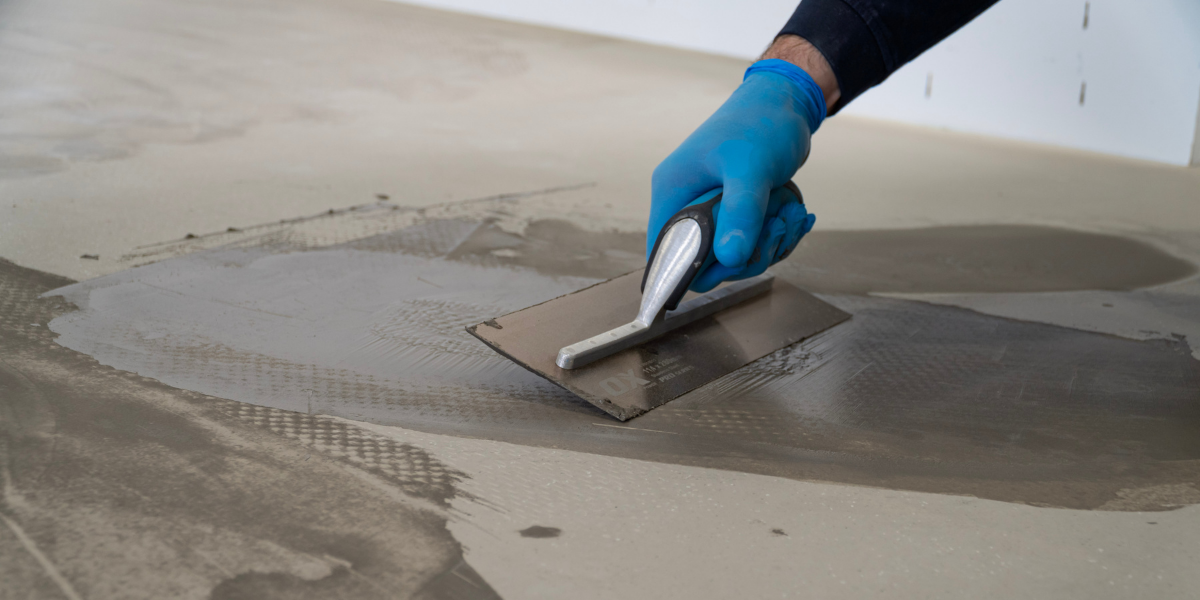
Applying a feather finishing product, such as Bostik RENO C700 FEATHERING FINISH, as the final stage of preparation helps eliminate surface irregularities and repair minor damage before floor coverings are installed. Feather finishes are suitable for skim-coating, patching, and filling, making them ideal for addressing imperfections prior to installing sheet vinyl or LVT. They are also effective for preparing plywood substrates, filling joints, and correcting fixing depressions. Rapid-drying formulations allow work to progress efficiently, making these products suitable for both domestic and commercial environments.
Getting the details right
Attention to these finer details in subfloor preparation results in a smooth, visually consistent finish that reflects professional workmanship and supports the long-term performance of the floor.
